


Latest Fortinet FCSS_ADA_AR-6.7 First Attempt, Exam real Dumps Updated [Jun-2026]
Get the superior quality FCSS_ADA_AR-6.7 Dumps Questions from BraindumpsIT. Nobody can stop you from getting to your dreams now. Your bright future is just a click away!
NEW QUESTION # 31
Refer to the exhibit.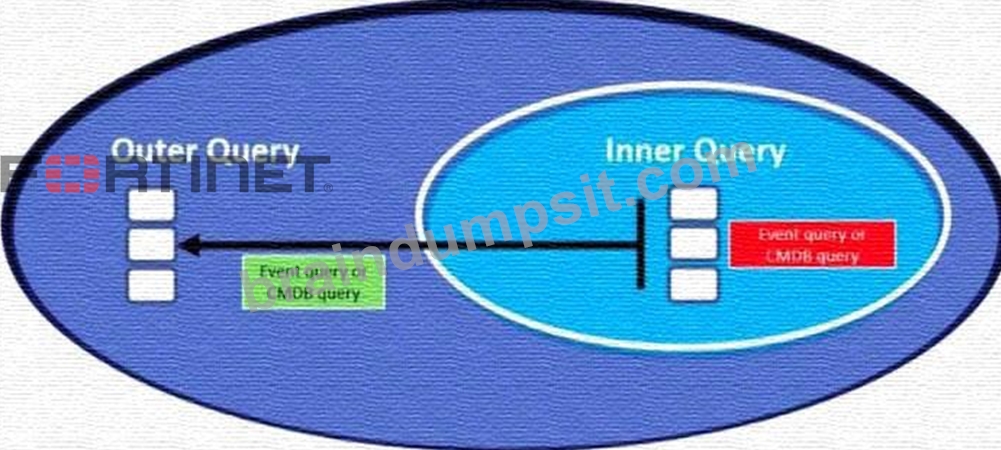
Which scenario is not a supported nested query scenario?
- A. The outer query is the event query, and the inner query is the event query.
- B. The outer query is the CMDB query, and the inner query is the event query.
- C. The outer query is the CMDB query, and the inner query is the CMDB query.
- D. The outer query is the event query, and the inner query is the CMDB query.
Answer: C
Explanation:
FortiSIEM does not allow CMDB queries to be nested within other CMDB queries. CMDB data is static information, and nesting would not add value or function properly in query execution.
NEW QUESTION # 32
Which two statements about the maximum device limit on FortiSIEM are true? (Choose two.)
- A. The device limit is defined for the whole system and is shared by every customer on a service provider edition.
- B. The device limit is based on the license type that was purchased from Fortinet.
- C. The device limit is only applicable to enterprise edition.
- D. The device limit is defined per customer and every customer is assigned a fixed number of device limit by the service provider.
Answer: A,B
Explanation:
FortiSIEM enforces a device limit based on licensing and system-wide constraintsto ensure proper resource allocation and performance management.
The device limit is determined by the purchased license.
# FortiSIEM licensing includes limits on thenumber of devicesthat can be monitored.
# Thelicense type(e.g.,Enterprise vs. Service Provider) defines themaximum number of devicessupported.
For Service Provider editions, the device limit applies system-wide and is shared across all customers.
# In anMSSP (Managed Security Service Provider) setup, the totaldevice limit applies across all customers, rather than being allocated individually.
# This allowsflexible resource allocationbased on customer needs.
NEW QUESTION # 33
Which three statements about collector communication with the FortiSIEM cluster are true? (Choose three.)
- A. Collectors communicate periodically with the supervisor node.
- B. The supervisor periodically checks the health of the collector.
- C. Collectors upload event data to any node in the worker upload list, but report their health directly to the supervisor node.
- D. The supervisor does not initiate any connections to the collector node.
- E. The only communication between the collector and the supervisor is during the registration process.
Answer: A,C,D
NEW QUESTION # 34
In the context of Clear Conditions and Remediation, which advantage does automation provide?
- A. Reducing response times to incidents and minimizing potential damage?
- B. Changing user access permissions based on their job roles?
- C. Increasing the frequency of software updates?
- D. Introducing more complex incidents for training purposes?
Answer: A
NEW QUESTION # 35
Which two statements about phRuleWorker are true? (Choose two.)
- A. phRuleWorker uses a 60-second bucket as an evaluation window.
- B. phRuleWorker exists on the worker only.
- C. phRuleWorker exists on both the supervisor and workers.
- D. phRuleWorker evaluates non-aggregate conditions as defined in subpattern filters of a rule in memory.
Answer: A,C
Explanation:
phRuleWorker processes events in 60-second intervals (buckets). This means that events within a one-minute window are evaluated together for rule conditions, helping detect patterns, correlations, and triggers.
phRuleWorker runs both on the supervisor and worker nodes to distribute event processing. The supervisor primarily orchestrates rule evaluation, while workers handle distributed event processing.
NEW QUESTION # 36
Refer to the exhibit.
The collector is registered and has pulled the license file from the supervisor.
What are the consequences of removing the license file?
- A. The collector must be re-registered with the supervisor to get the license file back.
- B. The license file must be pushed manually from the supervisor.
- C. The collector processes will go down.
- D. The collector must be redeployed to get the license file back.
Answer: A
Explanation:
Thelicense filelocated at/etc/opsd/.fortisiem4x0is critical for thecollector's operation, as it verifies the collector'sregistration with the supervisorand enables proper functionality.
If thislicense file is removed, the collector:
# Willlose its registrationwith the supervisor.
# Willstop receiving updates and configurationsfrom the FortiSIEM supervisor.
# Will requirere-registrationwith the supervisor to obtain a new license file.
NEW QUESTION # 37
For an MSSP looking to provide SOC solutions to multiple clients, the most scalable and efficient approach would be to:
- A. Deploy a multi-tenancy SOC solution.
- B. Frequently change SOC vendors for the best deals.
- C. Set up individual SOC environments for each client.
- D. Use a single agent across all client networks.
Answer: A
NEW QUESTION # 38
Refer to the exhibit.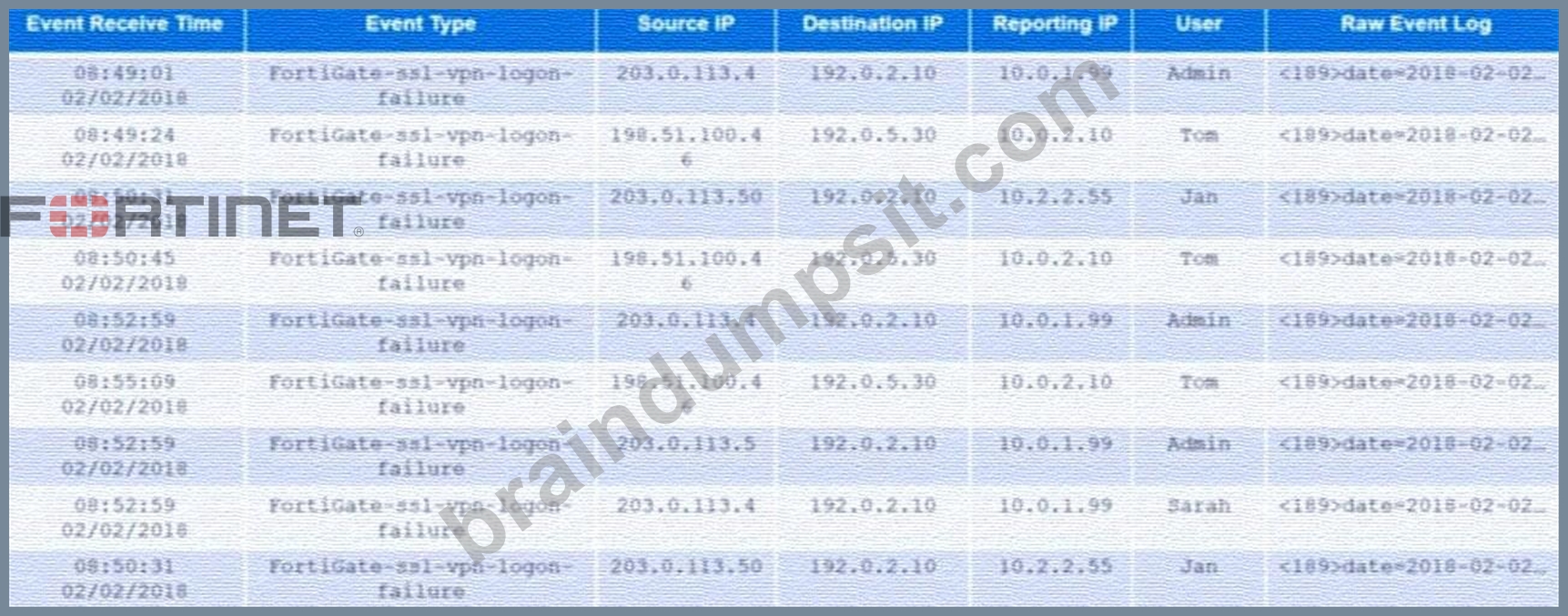
An administrator runs an analytic search for all FortiGate SSL VPN logon failures. The results are grouped by source IP, reporting IP, and user. The administrator wants to restrict the results to only those rows where the COUNT >=3.
Which user would meet that condition?
- A. Tom
- B. Jan
- C. Admin
- D. Sarah
Answer: C
Explanation:
The administrator is running an analytic search that groups results bySource IP, Reporting IP, and User, and filters only those with aCOUNT >= 3.
Looking at the data:
#Adminhas three failed attempts from thesame Source IP (203.0.113.4)andReporting IP (10.0.1.99).
#JanandSarahappear onlyonce or twicein the dataset.
#Tomhasmultiple entries, but they are fromdifferent Source IPs and Reporting IPs, meaning they are not counted as three under the same group.
NEW QUESTION # 39
How can you invoke an integration policy on FortiSIEM rules?
- A. Through remediation scripts
- B. Through Notification Policy settings
- C. Through External Authentication settings
- D. Through Incident Notification settings
Answer: B
Explanation:
InFortiSIEM, anintegration policycan be invokedthrough Notification Policy settings. This allows automated responses such as:
# Sending alerts toexternal systems (e.g., SIEMs, ticketing systems, SOAR platforms).
# Triggering actions based on specificincident rules.
# Integrating withthird-party solutionsforremediation, escalation, or logging.
NEW QUESTION # 40
What happens to events that the collector receives when there is a WAN link failure between the collector and the supervisor?
- A. Events are buffered for up to 24 hours.
- B. Events are buffered up to 10 MB before compression.
- C. Events are buffered up to 1 GB after compression.
- D. Events are buffered up to 10.000 logs.
Answer: C
Explanation:
When a WAN link failure occurs between the collector and the supervisor in FortiSIEM:
# The collector does not discard events; instead, it buffers them until the connection is restored.
# The buffering limit is up to 1 GB after compression to optimize storage and prevent data loss.
# Once the WAN link is restored, buffered events are sent to the supervisor for processing.
NEW QUESTION # 41
Refer to the exhibit.
The exhibit shows the output of an SQL command that an administrator ran to view the natural_id value, after logging into the Postgres database.
What does the natural_id value identify?
- A. The collector
- B. An agent
- C. The worker
- D. The supervisor
Answer: A
Explanation:
The natural_id value in the ph_sys_connector table of the FortiSIEM Postgres database uniquely identifies a collector.
*The SQL query retrieves details from ph_sys_connector, which stores information about registered collectors.
*The cust_org_id field indicates the organization ID the collector belongs to.
*The name field shows the collector's name (OrgA_Collector).
*The ip_addr field lists the collector's IP address (10.10.2.91).
*The natural_id value uniquely identifies the collector in the system.
NEW QUESTION # 42
Which three statements about phRuleMaster are true? (Choose three.)
- A. phRuleMaster is present on the supervisor and workers.
- B. phRuleMaster wakes up to evaluate all the rule data in parallel, even/ 30 seconds
- C. phRuleMaster wakes up to evaluate all the rule data in series, every 30 seconds.
- D. phRuleMaster queues up the data being received from the phRuleWorkers into buckets.
- E. phRuleMaster is present on the supervisor only
Answer: B,D,E
NEW QUESTION # 43
Refer to the exhibit.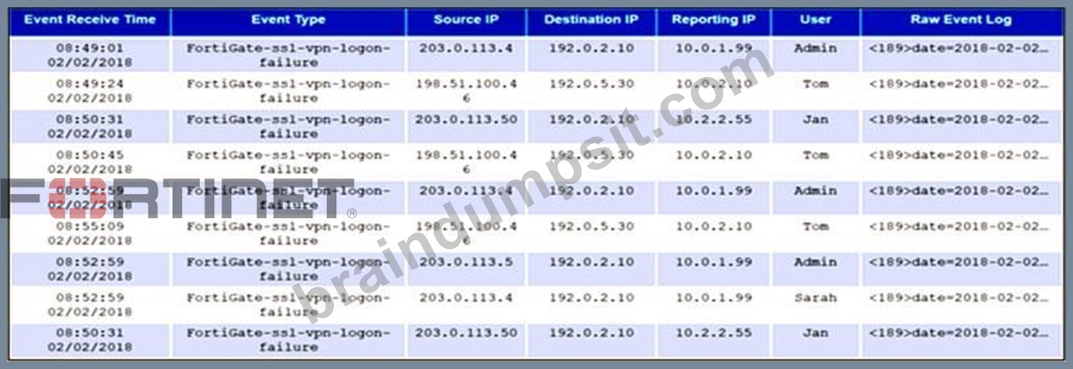
An administrator runs an analytic search for all FortiGate SSL VPN logon failures. The results are grouped by source IP, reporting IP, and user. The administrator wants to restrict the results to only those rows where the COUNT >= 3.
Which user would meet that condition?
- A. Jan
- B. Tom
- C. Admin
- D. Sarah
Answer: B
NEW QUESTION # 44
A service provider purchases a licensed EPS of 520. The guaranteed EPS allocated to three customers is 50,
100, and 150 respectively. At the end of every three-minute interval, incoming EPS is calculated at every collector and the value is sent to the central decision-making engine on the supervisor node.
The incoming EPS for the first collector is 25. the incoming EPS for the second collector is 50, and the incoming EPS for the third collector is 75.
Based on the information provided, what is the unused events total calculated by the supervisor?
- A. 76.000
- B. 35.960
- C. 71.460
- D. 75.960
Answer: C
Explanation:
Guaranteed Allocation:50 + 100 + 150 = 300 EPS
Actual (Incoming) Usage:25 + 50 + 75 = 150 EPS# Unused from guarantees = 300 # 150 = 150 EPS Burst Capacity (Licensed minus Guaranteed):520 # 300 = 220 EPS Total Unused Capacity:150 + 220 = 370 EPS As a Percentage of Licensed EPS:370/520 # 71.15% # reported (after conversion/rounding) as ~71.460
NEW QUESTION # 45
A service provider purchased a 500-EPS license and configured a new collector with 100 EPS for customer A, and another collector with 200 EPS for customer B.
How much is in the remaining EPS pool for future customers and for MSSP itself?
- A. 0
- B. 1
- C. 2
- D. 3
Answer: C
Explanation:
Total EPS License Purchased: 500 EPS
Allocated EPS:
# Customer A: 100 EPS
# Customer B: 200 EPS
Remaining EPS Pool:
500 # (100 + 200) = 200 EPS
NEW QUESTION # 46
Refer to the exhibit.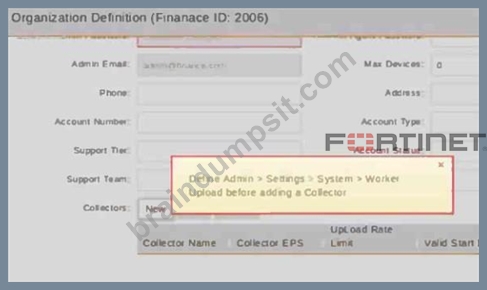
A service provider does not have a dedicated worker in the cluster, but still wants to add a collector to an organization.
What option does the administrator have?
- A. Install a worker
- B. Define a pseudo address as a worker IP address
- C. Ignore the warning and continue adding the collector
- D. Define the supervisor IP address as a worker unload address
Answer: D
Explanation:
In FortiSIEM, collectors need to upload event logs to a worker node for processing. However, if there is no dedicated worker, the supervisor can function as the worker to receive data.
*The error message suggests that a worker upload address must be defined before adding a collector.
*Since there is no dedicated worker, the administrator can set the Supervisor IP as the upload destination to enable log collection.
NEW QUESTION # 47
......
Guaranteed Success with Valid Fortinet FCSS_ADA_AR-6.7 Dumps: https://examtorrent.braindumpsit.com/FCSS_ADA_AR-6.7-latest-dumps.html